01
Individuals
The people whose presence, care and expectations shape your social ecosystem.
Research
We study what helps people move from disconnection towards sustained Social Health, then turn what we learn into language and practices leaders can use.
1,200+
people leaders researched
52%
survey response rate
13
in-depth interviews
8 weeks
pilot, with three-month follow-up
Conceptual contribution
We use this framework to describe movement from disconnection and unmet social needs towards social wellbeing and Social Wealth.
Through qualitative interviews, we asked leaders to locate themselves on the continuum in personal and professional life. It clarified unmet social needs, relational blind spots and opportunities for deliberate investment.
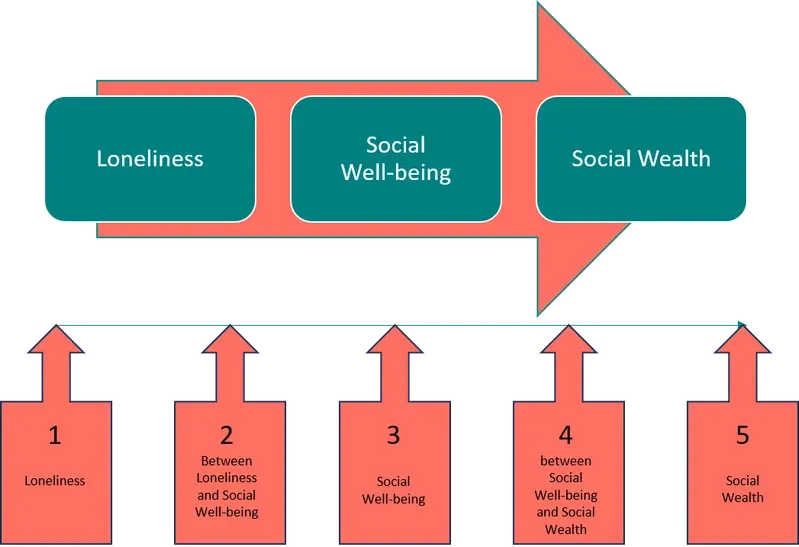
Figure note. Conceptual framework developed through qualitative interviews and thematic analysis. The stages indicate position along a continuum rather than a clinical classification.
The framework
A social ecosystem is the network of people, places and spaces that shapes human experience.
01
The people whose presence, care and expectations shape your social ecosystem.
02
The communities and collectives where belonging, reciprocity and shared identity take form.
03
The physical settings that make repeated, voluntary connection possible.
04
The environments, including online spaces, in which connection is made and maintained.
05
The people, voices and ideas that shape what you notice, value and practise.
06
The digital channels through which relationships, groups and information move.
The Communiverse™ is our author-developed reflective framework, a conceptual aid for reflection and intervention planning, not a validated diagnostic tool. © Shelley Doyle, The Communiverse™
Forthcoming paper
Shelley Doyle
A peer-reviewed paper in press
1,200+ people leaders
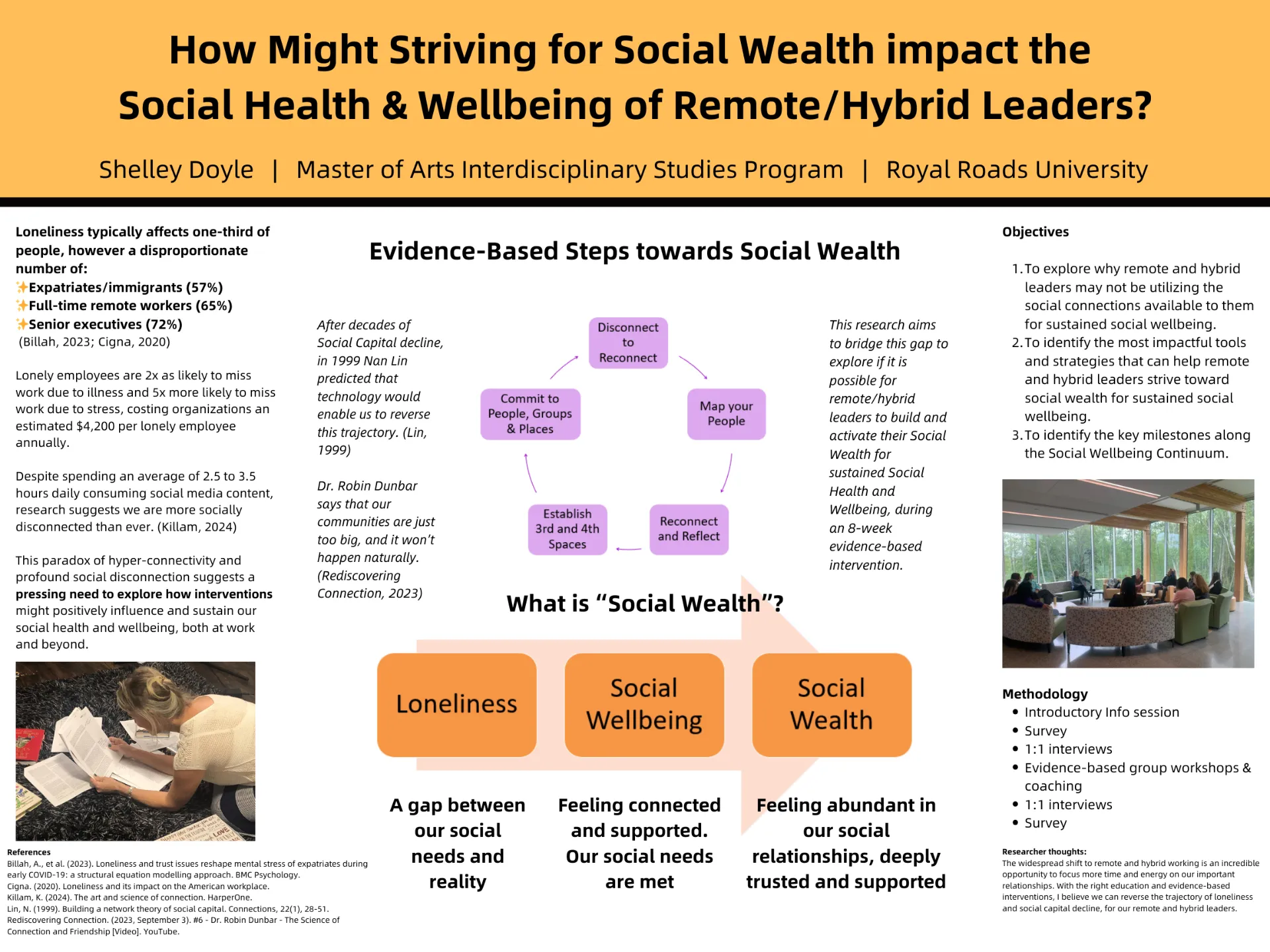
The precise study breakdown is 1,218 remote and hybrid people leaders at a Canadian financial services firm, 13 in-depth interviews, an eight-week Social Wealth Activation pilot with a three-month follow-up, a research partnership with a financial services firm in Canada and a Mitacs Accelerate Award.
Through extensive literature review and large-scale data, Shelley conceptualised the Social Wealth Continuum: Loneliness → Social Well-being → Social Wealth.
The paper contributes to the field of social capital by extending discussion beyond network resources and utility towards an applied model of relational resourcing and sustained social health. It also offers practical implications for workplace well-being, leadership development, and scalable approaches to supporting social health among remote and hybrid professionals.
Participants who completed the intervention reported greater awareness of their closest connections, more intentional approaches to maintaining reciprocal relationships, and positive movement on the Social Wealth Continuum, especially among those who initially reported loneliness.
Keywords: professional loneliness; social health; social capital; social wealth; distributed work; flexible work; people leaders.
Request the paperMaster’s thesis
Royal Roads University, 2025
How Relational Investment Shapes the Social Wellbeing of Remote and Hybrid People Leaders in Canada.
In the thesis, we examined how people leaders experience social wellbeing and how relational habits influence movement along a continuum from disconnection to social wellbeing and Social Wealth.
We define relational risk as the conditions that make it harder for people to build trust, access support and maintain useful connection at work.
Our research design combined survey data, qualitative interviews and thematic analysis. The findings are qualitative and self-reported. They describe experience and patterns rather than proving causation.
Sample size and full methodology are available on request.
From research to practice
01
The research pilot was an eight-week intervention for mapping social ecosystems, identifying risk indicators, establishing places, spaces and Rituals of Connection, and reflecting on shifts in perceived Social Health. The current programme offer has since been extended to twelve weeks. The pilot’s full name was Social Wealth Activation for Sustained Social Health.
The pilot showed promise as an applied intervention. Its results are exploratory, self-reported and not proof of causation.
02
We use assessments to identify the conditions that make trust, belonging and useful connection harder to sustain, establish baseline Social Health measures, implement proportionate interventions and track impact over time.
Why this research matters
We see leaders carrying relational strain quietly while organisations adapt how people connect and collaborate. Loneliness is real, but we do not want it to be the only organising idea. Social Health is a leadership capability and an organisational sustainability issue.
In June 2025, the World Health Organization published “From Loneliness to Social Connection: Charting a Path to Healthier Societies”, the report of the WHO Commission on Social Connection. It recognises social health as the third pillar of public health, alongside physical and mental health, and calls on organisations and countries to invest in policy, research, scalable interventions, measurement and awareness campaigns.
“While the World Health Organization's recognition of social health is significant, it is insufficient without language that professionals can resonate with and evidence-based guidance they can take action on.”
World Health Organization (2025). From Loneliness to Social Connection: Charting a Path to Healthier Societies.
WHO figure
The World Health Organization's framing places social health alongside physical and mental health. This figure gives the research context a clear visual form.
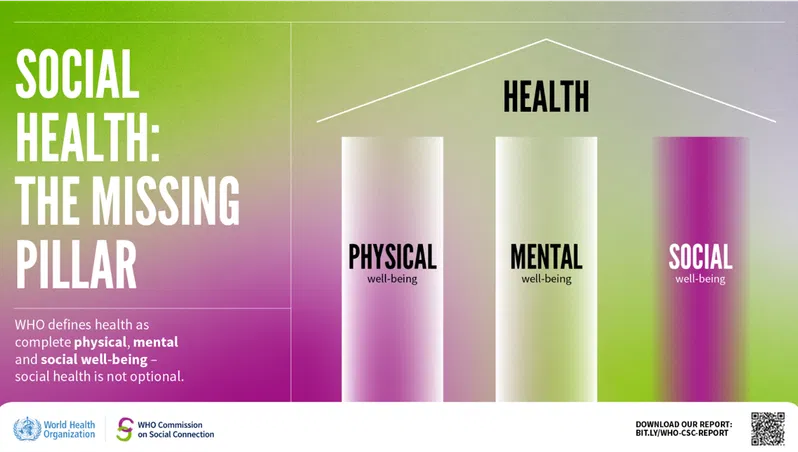
Adapted from "Infographic: Social health, the missing pillar," World Health Organization (2025).
Continue the conversation